When you spend as much time on the court as I do, you start to notice the tectonic shifts in paddle manufacturing before they hit the mainstream. I've tested over 200 paddles in my journey from tennis pro to pickleball coach, and I've got to tell you, the market is overflowing with carbon copy paddles. But every once in a while, a brand steps onto the court with a philosophy that makes you stop and take notice. Enter Carbonebula.
Brand Overview and Philosophy
This brand isn't interested in splashing neon graphics across their paddles just to catch your eye on a crowded rack. Their approach is distinctly methodical, focusing on aerospace-grade materials over marketing hype.
What strikes me as a mentor in this sport is how they’ve managed to democratize high-level engineering. They are building equipment for players who want to transition from recreational dinking to power baseline rallies without taking out a second mortgage.
What Sets Carbonebula Apart
If we’re going to talk about what makes this gear unique, we have to look under the hood. Their signature tech is a Thermoformed Unibody Construction combined with a Teflon-Coated paddle face. It's a combination you usually only see in paddles that cost double the price.
For those scratching their heads, thermoforming is a manufacturing process where heat and pressure mold the paddle into a single, cohesive piece. This process creates a massive sweet spot—the optimal hitting area on the paddle face—and dramatically increases durability. The Teflon-coating is an interesting twist, designed to give the paddle an edge in consistency and wear resistance while letting the T700 unidirectional carbon fiber do the heavy lifting for spin generation.
What exactly does a massive sweet spot do for my game? expand_more
A larger sweet spot ensures that even off-center hits maintain good pace and direction. It essentially forgives your slight mis-hits, keeping your dinks and drives consistent.
Is a Teflon coating legal for tournament play? expand_more
Yes! As long as the paddle passes the USAPA's surface roughness test, coatings designed for durability and consistency are perfectly legal.
Top Paddles by Category
While some brands boast catalogs thick as a phone book, this company has focused its energy on refining a core offering that punches well above its weight class. You won't find fifty variations of the same paddle here.
Best Overall and Best Value: Pro C5 Pickleball Paddle
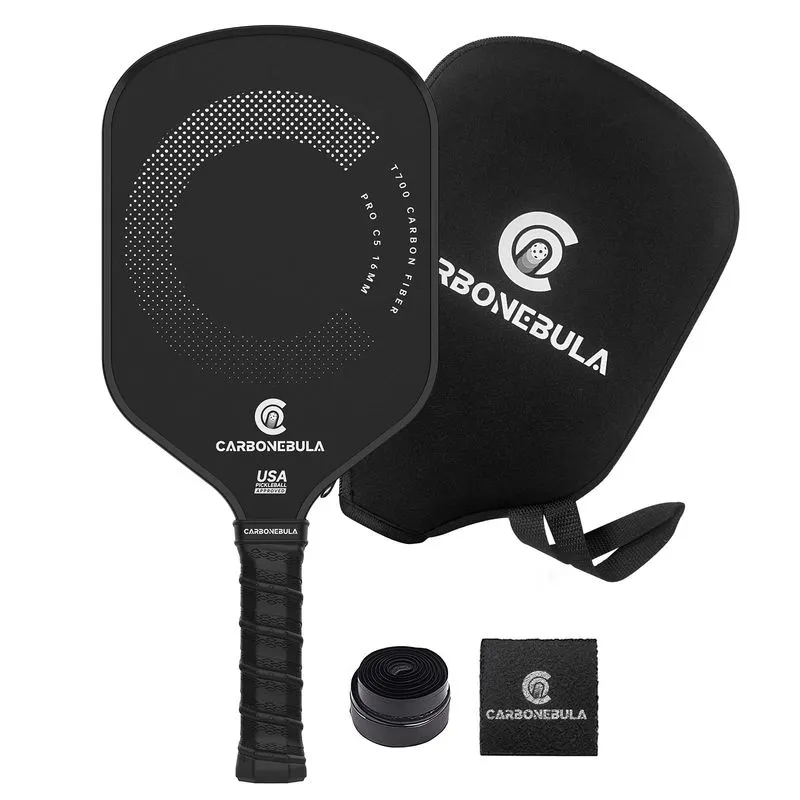
It’s rare to find a single paddle that captures both the "Flagship" and "Budget Pick" titles, but at under $70, the Carbonebula Pro C5 does exactly that. Weighing in at 8.11 ounces, this paddle utilizes a 16mm polymer core (polypropylene honeycomb) that provides a plush, controlled feel for touch shots at the kitchen line.
What I appreciate most about the Pro C5 is its swing weight—a measure of how heavy the paddle feels during motion, influenced by the moment of inertia. It feels nimble enough for fast hands battles but carries enough mass to drive the ball deep into the opponent's court.
The T700 carbon fiber surface grabs the ball beautifully, giving you the friction needed to hit heavy topspin drops. When I hand this to my students, the first thing they notice is the immediate upgrade in their ability to roll volleys out of the air.
Brand Reputation and Customer Experience
Let's talk brass tacks. The brand delivers phenomenal value, and the fact that the Pro C5 is USAPA Approved means you can take it straight to a tournament. You don't have to worry about the referee tossing your paddle out during inspection.
However, honesty is my policy. The brand currently offers a very limited 1-Month warranty. In an industry where 6-month to lifetime warranties are becoming standard, this is a distinct weakness. If you are exceptionally hard on your gear—smacking the edge guard on the court every time you miss a dig—this short coverage window is something to keep in mind.
How the Pro C5 Compares to Competitors
When you stack this brand up against similar competitors offering raw carbon fiber and thermoformed tech, the value proposition is hard to ignore. Most top-tier unibody paddles sit well over the hundred-dollar mark.
Finding high-performance specs in the budget category is usually a game of compromises, but in this case, the core construction remains uncompromised. Let's look at the numbers side-by-side.
| Feature | Carbonebula Pro C5 | Typical $150+ Competitor |
|---|---|---|
| Core Material | 16mm Polypropylene | 16mm Polypropylene |
| Face Material | T700 Carbon Fiber w/ Teflon | Raw Carbon Fiber |
| Construction | Thermoformed Unibody | Thermoformed Unibody |
| Price | Under $70 | $150 - $220 |
| Warranty | 1 Month | 6 Months - Limited Lifetime |
| Buy on Amazon |
The Pro C5 clearly wins on budget and entry-to-advanced performance, even if the warranty leaves a bit to be desired. It's the kind of paddle that levels the playing field against opponents swinging much more expensive gear.
I constantly remind players that technique trumps tech, but having a tool like this certainly accelerates the learning curve. You can execute high-level shots without draining your bank account.
Our Top Pick

Carbonebula
Carbonebula Pro C5 Pickleball Paddle
For players looking to break into the advanced paddle market without taking on a massive price tag, the Carbonebula Pro C5 is an absolute steal. It delivers top-tier thermoformed power and spin at a fraction of the cost.
Wrapping Up
If you're a player looking to upgrade to top-tier thermoformed tech without the top-tier price tag, this paddle deserves a spot in your bag. Just remember to treat your equipment with care, and it will reward you with exceptional pop and precision on the courts.
As you continue to refine your mechanics, gear like this serves as the perfect bridge between recreational fun and serious competitive play. Keep your eye on the ball, trust your swing, and I'll see you on the courts!
Is the Carbonebula Pro C5 good for beginners? expand_more
Absolutely. While it boasts advanced materials, the 16mm core makes it plush and controllable, which helps beginners keep the ball in play while they develop their swing mechanics.