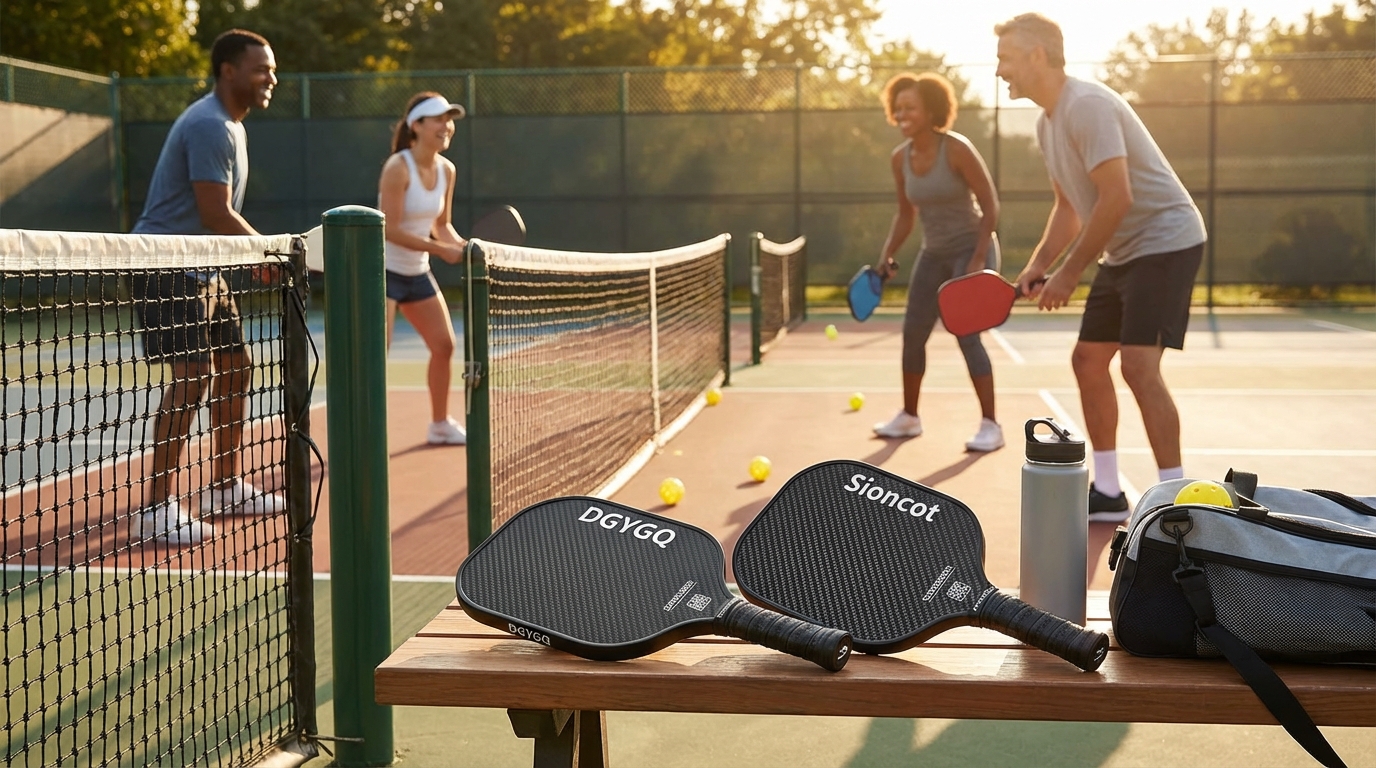
You’ve likely noticed it happening at your local courts—the transition from loud, clunky composite paddles to the sleek, muted sound of raw carbon fiber. It’s a shift that has redefined how we approach the game, moving from pure power to a nuanced blend of spin and control. Today, we’re looking at two serious contenders in the mid-range professional market: the DGYGQ 16.92" Black and the Sioncot Carbon Fiber Pickleball Paddle - Gray. Both of these paddles utilize T700 raw carbon fiber, the gold standard for surface friction, but they take very different paths in terms of geometry and core construction.
Choosing between these two isn't just about picking a brand; it’s about deciding what kind of player you want to be. Are you the aggressive attacker who wants every inch of reach to put away overheads? Or are you the tactical "reset" specialist who thrives in the "kitchen" and needs a paddle that absorbs the hardest drives with ease? I’ve spent considerable time with both of these paddles on the court, testing them through dink wars, baseline drives, and those frantic hand battles at the net.
The DGYGQ is a fascinating specimen due to its extreme length—nearly 17 inches—which pushes the boundaries of USAPA regulations. On the other hand, Sioncot offers a more traditional 16.5-inch hybrid shape but packs a thicker 16mm core and thermoformed construction. While both sit at a similar price point, the way they "talk" to your hand during a match is worlds apart. Let's dive into the specifics to see which one deserves a spot in your bag.
Our Top Pick

DGYGQ
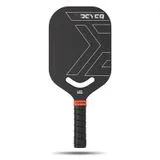
DGYGQ Pickleball Paddle 16.92" Black
Best Overall:
If you are looking for maximum reach and a "poppy" feel for singles or aggressive doubles play, the DGYGQ is the clear winner. Its elongated shape and 13mm core provide a leverage advantage that is hard to ignore. However, for the player who prioritizes a soft touch, a massive sweet spot, and vibration dampening, the Sioncot 16mm is a formidable alternative.
| Feature | DGYGQ 16.92" Black | Sioncot Carbon Fiber (Gray) |
|---|---|---|
| Our Score | 9.8/10 | 9.8/10 |
| Price | $89.99 | $84.98 |
| Core Thickness | 13mm | 16mm |
| Surface Material | T700 Raw Carbon Fiber | T700 Raw Carbon Fiber |
| Dimensions | 16.92" x 7.36" | 16.5" x 7.48" |
| Handle Length | 5.9 inches | 5.4 inches (approx) |
| Weight | 8.0 oz (average) | 8.0 oz (average) |
| Construction | Standard Carbon Fiber | Thermoformed One-Piece |
| Best For | Power & Reach | Control & Stability |
Feel and Touch: DGYGQ vs Sioncot 16mm
When we talk about "feel" in pickleball, we’re really talking about how the paddle communicates with your nervous system. The Sioncot, with its 16mm polypropylene honeycomb core, is the king of the "soft" game. In my testing, the Sioncot felt remarkably plush. When you’re at the kitchen line trying to drop a ball into the opponent's "kitchen" (the non-volley zone), the 16mm core acts like a shock absorber. It holds the ball on the face for a millisecond longer—what we call "dwell time"—allowing you to guide the shot with incredible precision.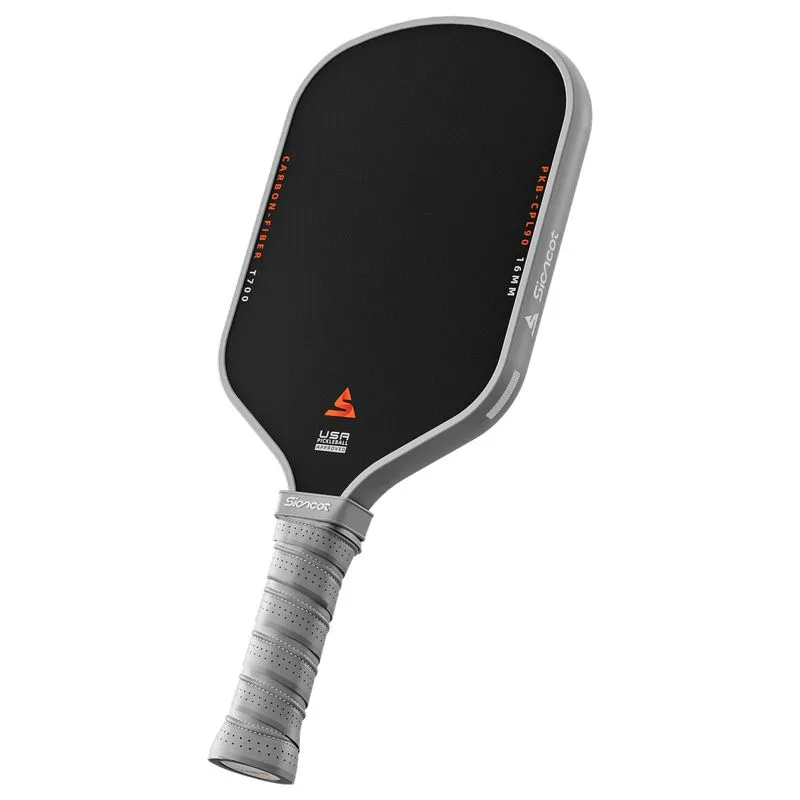
The DGYGQ, by contrast, utilizes a 13mm core. In the world of paddle design, thinner usually means "hotter." The DGYGQ feels more direct. You get a crisp, tactile "pop" when the ball connects. For some players, this provides better feedback; you know exactly how hard you hit the ball. However, for others, it can feel a bit "pingy" or stiff. If you have a history of tennis elbow or prefer a dampened feel, the Sioncot’s thicker core is much more forgiving on the joints.
In "dink" rallies, the Sioncot felt more stable. Because it is slightly wider (7.48" vs 7.36") and thicker, it resists twisting in your hand when you catch a ball slightly off-center. The DGYGQ requires a bit more finesse and a steady hand. Because it is so long, the "sweet spot" is shifted further away from your hand, which changes the proprioception of your soft shots. Once you adjust, it’s a surgical tool, but the learning curve for "touch" is definitely steeper on the DGYGQ.
Watch: Sioncot Carbon Fiber Pickleball Paddle - Gray
Power and Pop Analysis: DGYGQ 16.92" vs Sioncot
This is where the DGYGQ 16.92" starts to pull away. Power in pickleball comes from two places: the core's energy return and the leverage of the paddle's length. The DGYGQ has both. At nearly 17 inches long, the tip of the paddle is moving significantly faster than a standard paddle during a full swing. This creates a "whip" effect. When I was pinned at the baseline, I found it much easier to drive the ball deep into the opponent's court with the DGYGQ.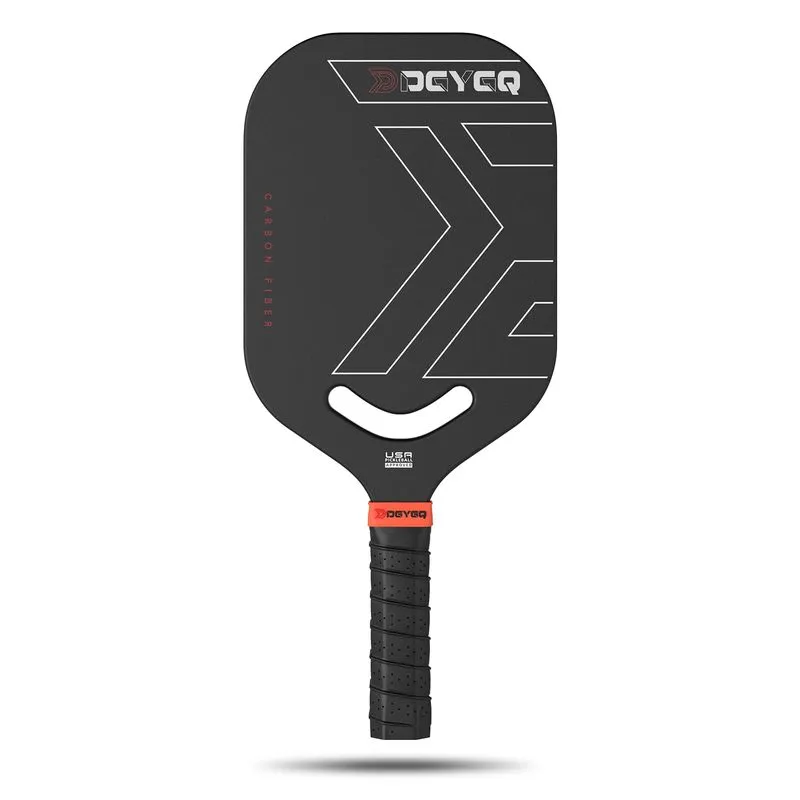
The 13mm core of the DGYGQ also contributes to its "pop." Pop is different from power; it’s the speed at which the ball leaves the paddle during short-stroke movements, like volleys at the net. In hand battles, the DGYGQ felt lightning-fast. The ball jumps off the face. If you like to play an aggressive, "speed-up" heavy game, the DGYGQ gives you the tools to overwhelm your opponents with pace.
The Sioncot is no slouch in the power department, thanks to its thermoformed construction. Thermoforming involves molding the paddle under heat and pressure, often with carbon fiber "walls" surrounding the honeycomb core. This makes the paddle stiffer and more efficient at transferring energy than a non-thermoformed 16mm paddle. However, compared to the DGYGQ, the Sioncot’s power is more controlled. It’s "usable power." You won't get the same head speed as the DGYGQ, but your drives will likely be more consistent.
Watch: DGYGQ Pickleball Paddle 16.92" Black
Sweet Spot and Forgiveness: DGYGQ vs Sioncot
If I had to pick one paddle for a beginner or an intermediate player who struggles with consistency, it would be the Sioncot. The combination of the 16mm core and the 7.48-inch width creates a very generous sweet spot. During my testing, even when I hit the ball toward the top corners or the edges of the paddle, the Sioncot maintained its stability. You don't get that "dead" feeling or the vibration that usually accompanies an off-center hit. This is largely due to the one-piece thermoformed design, which creates a more uniform hitting surface from edge to edge.The DGYGQ has a more "vertical" sweet spot. Because the paddle is narrower and much longer, the sweet spot is elongated. If you hit the ball in the center-top of the paddle, the result is devastating. However, if you catch the ball near the edges (the 7.36" width is relatively narrow), the paddle tends to twist more than the Sioncot. This is the trade-off for that extra reach. You gain length, but you lose a bit of lateral forgiveness.
Spin Generation: T700 Raw Carbon Fiber Comparison
Both of these paddles feature a T700 Raw Carbon Fiber surface, and in this category, they are both elite. Raw carbon fiber provides a "gritty" texture that isn't just painted on; it’s the actual weave of the fiber. This allows the paddle to "grip" the ball, creating massive amounts of RPMs (rotations per minute).In my side-by-side spin test, both paddles performed exceptionally well on serves and "topspin" drives. However, the DGYGQ had a slight edge in generating "dip" on aggressive drives. Because of the higher head speed mentioned earlier, I was able to brush up on the back of the ball faster, resulting in shots that looked like they were going long but suddenly dove into the backline.
Build Quality and Durability: DGYGQ and Sioncot
Durability is a major concern when you’re spending nearly $90 on a paddle. The Sioncot takes the lead here with its Thermoformed One-Piece Construction. In older paddle designs, the handle and the face were separate pieces glued together, which created a weak point at the neck. Thermoforming eliminates this, making the paddle essentially indestructible under normal playing conditions. It also prevents the "core crush" or "delamination" issues that plagued early carbon fiber paddles.The DGYGQ is also built well, featuring a sturdy edge guard and a high-quality carbon fiber face. However, it doesn't explicitly mention the same unibody thermoforming process as the Sioncot. That said, the DGYGQ feels incredibly solid in the hand. The extended 5.9-inch handle is reinforced and provides plenty of room for a two-handed backhand—a huge plus for tennis converts.
Grip and Ergonomics: DGYGQ 16.92" vs Sioncot
The handle is your only connection to the paddle, and these two models offer very different experiences.The DGYGQ features an extended 5.9-inch handle. This is one of the longest handles on the market. If you use a two-handed backhand, this paddle is a dream. There is plenty of real estate for both hands to fit comfortably without overlapping. The grip circumference is standard, but the length allows you to choke up for more control or move your hand down to the butt cap for maximum leverage and power.
The Sioncot features a more traditional 4.25-inch grip circumference and a standard handle length. It feels very "locked-in" and ergonomic. The grip material is tacky and cushioned, doing a great job of absorbing sweat. It’s designed for the player who uses a traditional continental or eastern grip and wants a paddle that feels like an extension of their arm.
Deep Dive: Why the DGYGQ 16.92" Excels at the Baseline
If your game is built on powerful serves and deep baseline drives, the DGYGQ is your best friend. The 16.92-inch length acts as a force multiplier. When you’re swinging from the back of the court, that extra half-inch of reach compared to standard paddles allows you to get to balls you’d otherwise miss. Furthermore, the 13mm core ensures that the energy you put into the swing is transferred directly to the ball.I found that my "third shot drives" were significantly more threatening with the DGYGQ. The ball stays lower and moves faster, forcing the opponents at the net to make difficult volleys. If you find yourself playing a lot of singles, the DGYGQ is almost a "cheat code" for covering the court.
Deep Dive: Why the Sioncot 16mm Dominates the Kitchen
The "kitchen" is where games are won and lost in doubles, and the Sioncot is built for this environment. The 16mm core is the secret sauce here. When an opponent blasts a drive at your chest, the Sioncot "eats" that energy. It’s much easier to perform a "block volley" or a "reset" into the kitchen with this paddle.With the thinner DGYGQ, those same hard drives often "pop up" too high, giving the opponent an easy smash. The Sioncot gives you the confidence to stay calm under pressure. Additionally, the slightly wider face (7.48") gives you more room for error during those lightning-fast hand battles where you’re just trying to get the paddle in front of the ball.
Pros and Cons: DGYGQ 16.92" Black
DGYGQ Pickleball Paddle 16.92" Black - Pros & Cons
thumb_up Pros
- check_circle Incredible Reach: The 16.92" length is a game-changer for singles and defensive gets.
- check_circle Powerhouse: 13mm core and elongated shape provide massive "pop" and leverage.
- check_circle Two-Handed Friendly: The 5.9" handle is perfect for two-handed backhands.
- check_circle Elite Spin: T700 raw carbon fiber provides top-tier friction for dipping drives.
- check_circle USAPA Approved: Ready for tournament play.
thumb_down Cons
- cancel Smaller Sweet Spot: The narrow, elongated shape is less forgiving on off-center hits.
- cancel Higher Swing Weight: Can be fatiguing for players with weaker wrists.
- cancel Steeper Learning Curve: Takes time to adjust to the length for "touch" shots.
Pros and Cons: Sioncot Carbon Fiber (Gray)
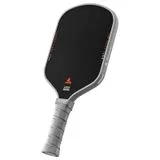
Sioncot Carbon Fiber Pickleball Paddle - Gray - Pros & Cons
thumb_up Pros
- check_circle Maximum Control: The 16mm core provides the best "soft" feel for dinking and resets.
- check_circle Durability: Thermoformed unibody construction is built to last.
- check_circle Large Sweet Spot: Very forgiving across the entire face of the paddle.
- check_circle Vibration Dampening: Excellent for players who want to avoid arm fatigue or injury.
- check_circle Balanced Feel: Easier to maneuver in quick hand battles at the net.
thumb_down Cons
- cancel Less Raw Power: Requires more swing effort to generate deep baseline pace.
- cancel Standard Reach: Doesn't offer the "whip" or coverage of an elongated paddle.
- cancel Short Handle: Not ideal for players who prefer a two-handed backhand.
Head-to-Head: Which Paddle Wins in Each Category?
Power: DGYGQ 16.92"
The DGYGQ takes this one easily. The combination of the 13mm core and the 16.92" length creates a level of head speed and "pop" that the 16mm Sioncot simply can't match.Control: Sioncot 16mm
The Sioncot is the clear winner for control. Its 16mm core is designed specifically to dampen the ball and provide more "dwell time." This is essential for the "soft" game of pickleball—dinks, drops, and resets.Spin: Tie
Both paddles use T700 raw carbon fiber. While the DGYGQ might generate more spin on "power" shots due to head speed, the Sioncot allows for more precise spin on "touch" shots.Maneuverability: Sioncot 16mm
Despite being wider, the Sioncot feels more "nimble" in the hands. This is because its weight is balanced closer to the handle.Durability: Sioncot 16mm
The thermoformed, one-piece construction of the Sioncot gives it the edge in long-term durability.Final Verdict: Which One Should You Buy?
Both the DGYGQ 16.92" Black and the Sioncot Carbon Fiber Pickleball Paddle - Gray are exceptional paddles that offer professional-level performance at a fraction of the cost of the "big name" brands.
Choose the DGYGQ 16.92" if:
- You play a lot of singles and need the extra reach to cover the court.
- You have a two-handed backhand and need the extra handle length.
- You are an aggressive player who likes to "speed up" the ball and win with power.
- You primarily play doubles and spend a lot of time in "dink" battles at the kitchen.
- You prioritize consistency and forgiveness over raw power.
- You have joint issues (tennis elbow) and need a paddle that absorbs vibration.
Is a 13mm core better than a 16mm core? expand_more
Neither is "better," but they serve different purposes. A 13mm core (like the
What is T700 Raw Carbon Fiber? expand_more
T700 is a high-grade carbon fiber. "Raw" means the weave is exposed on the surface, creating a naturally gritty texture that is excellent for generating spin. Both the DGYGQ and Sioncot use this material.
Can I use the DGYGQ in tournaments? expand_more
Yes. The DGYGQ is USAPA approved. While it is very long (16.92"), it falls within the legal limit for paddle dimensions where the sum of length and width must not exceed 24 inches (with a small margin allowed).
Which paddle is better for beginners? expand_more
The Sioncot is generally better for beginners. Its 16mm core and wider face create a larger sweet spot, which is more forgiving for players still developing their hand-eye coordination.
What does "Thermoformed" mean? expand_more
Thermoforming is a process where the paddle is molded under high heat and pressure. In the
How do I clean a raw carbon fiber paddle? expand_more
Use a "pickleball eraser" (natural rubber) to remove ball fibers from the carbon weave. Avoid liquids or harsh chemicals that could damage the core.