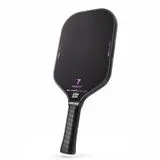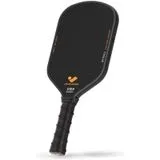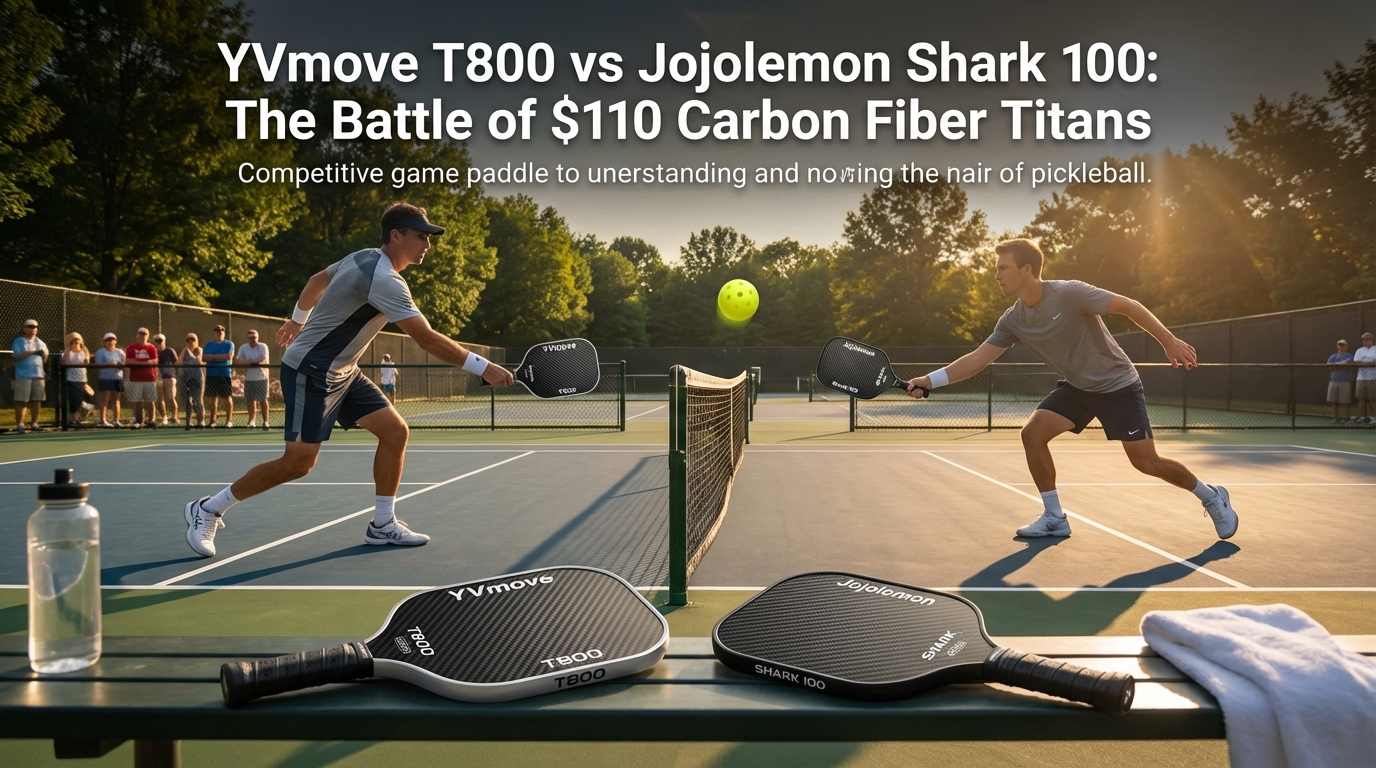
You have reached that point in your pickleball journey where the entry-level wooden or cheap composite paddle just isn't cutting it anymore. You are looking for more spin, a softer touch at the kitchen, and enough pop to finish points when the opportunity arises. This brings us to a very competitive price bracket: the $100 to $120 range. In this space, two paddles have been making serious waves for offering performance that rivals $250 legacy brands. I am talking about the YVmove T800 and the Jojolemon Shark 100.
Both of these paddles lean heavily into the 16mm thickness trend, which is the gold standard for players who prioritize control and a plush feel. They both utilize 3K carbon fiber, a material known for its stiffness-to-weight ratio and its ability to grab the ball for massive spin. However, despite their similar price points and specs on paper, they feel remarkably different once you step onto the court. Over the last few weeks, I have put both of these through the ringer in drills, recreational play, and local tournament matches to see which one truly deserves the 'pro-level' label.
Our Top Pick

Jojolemon
Jojolemon Shark 100 Pickleball Paddle
Best Overall:
While both are incredible values, the Jojolemon Shark 100 edges out the competition for aggressive players. Its thermoformed construction and 4-directional carbon weave provide a level of spin and "pop" that is hard to beat at this price, making it the more versatile weapon for modern, offensive pickleball.
| Feature | YVmove T800 Carbon Fiber | Jojolemon Shark 100 |
|---|---|---|
| Our Score | 9.8/10 | 9.8/10 |
| Price | $109.99 | $109.99 |
| Surface Material | T800 3K Carbon Fiber | 3K Raw Carbon Fiber |
| Core Thickness | 16mm V-Sonic IV | 16mm Shark Power Poly |
| Weight | 8.1 oz | 8.0 oz |
| Dimensions | 16.42" x 7.4" | 16.5" x 7.4" |
| Construction | Triangular Handle Joint | Thermoformed Single-Piece |
| Sweet Spot | Large / Forgiving | Very Large / Uniform |
| USAPA Approved | Yes | Yes |
Feel and Touch: Dampening vs Feedback
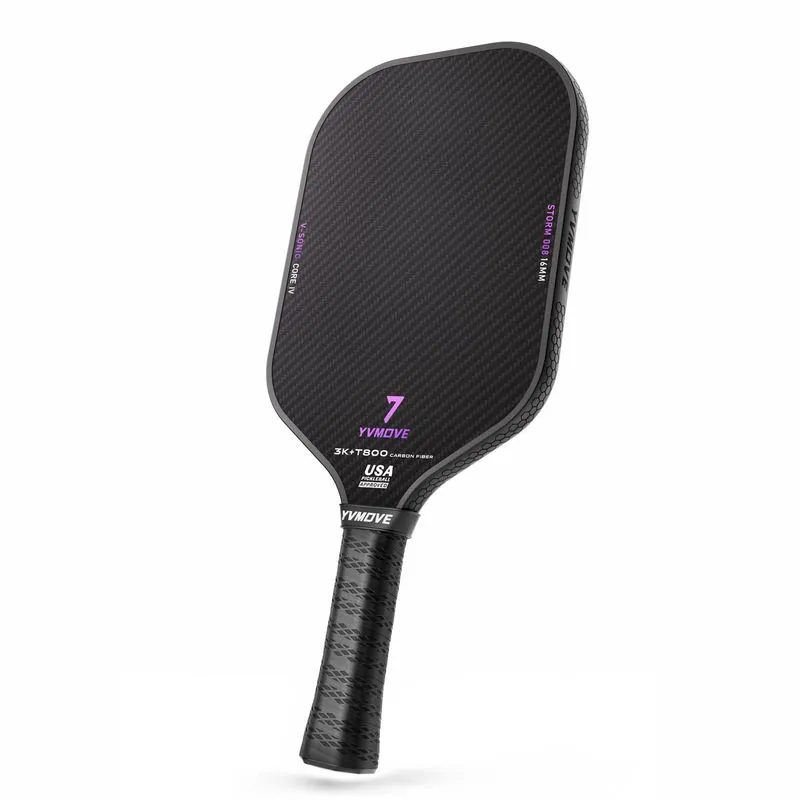
When we talk about 'feel' in pickleball, we are really talking about the paddle's ability to communicate what is happening at the point of impact. The YVmove T800 utilizes what they call the V-Sonic IV Dynamic Core. In my testing, this translated to a very dampened, quiet feel. If you are a player who loves to play the 'soft game'—those delicate third-shot drops and cross-court dinks—the T800 offers a level of vibration reduction that is quite impressive. The 16mm thickness really absorbs the energy of incoming fast balls, making it easier to reset the point and get back to the kitchen line.
On the other side, the Jojolemon Shark 100 features a 16mm Shark Power Polymer Core. While it is also a 16mm paddle, it feels slightly 'crisper' than the YVMOVE. You get a bit more feedback through the handle, which some players prefer for gauging the depth of their shots. The touch shots with the Shark 100 feel very intentional. It doesn't quite have that 'pillowy' sensation of the T800, but it offers a very predictable response. If the T800 is a luxury sedan with soft suspension, the Shark 100 is a sports sedan—you feel the road a bit more, but you also feel more connected to the ball.
In the kitchen, I found the YVmove T800 slightly more forgiving on off-center dinks. The triangular handle joint design seems to stabilize the paddle face during those reaching shots where you don't quite hit the dead center. However, the Jojolemon Shark 100 has a very uniform feel across the entire face due to its thermoformed construction. You won't find many 'dead spots' on either of these, but the YVmove wins slightly on pure vibration dampening.
Power and Pop: Stability vs Explosiveness
Power is often the trade-off when you go with a 16mm core, but both of these brands have used carbon fiber technology to mitigate that loss. The YVmove T800 uses aerospace-grade T800 carbon fiber. This is a higher tensile strength material than the standard T300 or T700 found in many budget paddles. When you really swing through a drive, the T800 face doesn't flex as much, which translates to more energy returning to the ball. I noticed that my baseline drives had a very heavy feel to them—not necessarily the fastest in terms of MPH, but they had a 'plow-through' effect that made them hard for opponents to volley back cleanly.
Watch: YVmove T800 Carbon Fiber Pickleball Paddle
The Jojolemon Shark 100, however, feels like it has a bit more 'pop.' Pop is that immediate speed off the face during hand battles at the net. Because the Shark 100 is thermoformed (a process where the paddle is molded under heat and pressure into a single piece), the edges are stiffer. This creates a trampoline effect that is more pronounced than the YVmove. In fast-paced volleys, the Shark 100 felt a fraction of a second faster. It’s an 8.0 oz paddle versus the YVmove's 8.1 oz, and while 0.1 oz sounds like nothing, the balance of the Shark 100 feels slightly more head-light, allowing for quicker hands.
If you are a power baseline player, you might prefer the stability and weight of the YVmove T800. If you are a 'banger' who thrives in fast hand battles at the net, the Jojolemon Shark 100’s pop and maneuverability give it a slight edge in the power category.
Spin Generation: The Battle of the 3K Weave
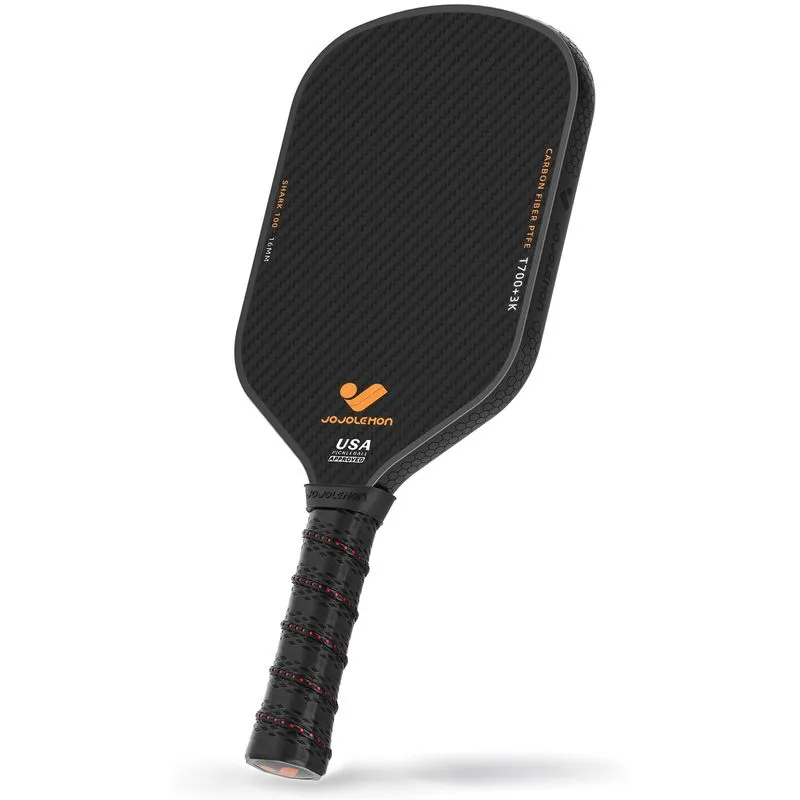
Spin has become the most sought-after attribute in modern pickleball, and both of these paddles deliver in spades. They both use 3K carbon fiber, which provides a naturally textured surface. The Jojolemon Shark 100 goes a step further with a '4-directional carbon weave.' When I ran my fingers across the surface, the Shark 100 felt noticeably grittier. On the court, this translated to some of the most aggressive topspin serves I’ve ever hit with a paddle under $150. The ball dives sharply at the baseline, making it a nightmare for opponents to time their returns.
The YVmove T800 is no slouch in the spin department either. It uses 'Enhanced Spin Technology' which is a proprietary coating over the T800 carbon fiber. While it doesn't feel quite as 'sandpaper-like' as the Jojolemon, the dwell time (how long the ball stays on the face) is slightly longer because the core is a bit softer. This extra millisecond of contact allows you to 'brush' the ball effectively. I found the YVmove to be exceptional for 'slice' returns and 'underspin' dinks. It offers a very controlled spin.
However, for raw RPMs (revolutions per minute), the Jojolemon Shark 100 is the clear winner. If your game relies on heavy topspin dips and sharp angles, the 'Shark' lives up to its name. It bites the ball and doesn't let go until it’s spinning like a top.
Sweet Spot and Forgiveness
The sweet spot is the area of the paddle where you get the most consistent power and least amount of vibration. For intermediate players, a large sweet spot is the difference between a winning volley and a ball that dies in the net. The YVmove T800's 16.42" x 7.4" frame is slightly shorter and wider-feeling than the Jojolemon, and that width seems to expand the sweet spot laterally. I felt very confident hitting backhands with the T800, even when I was slightly late on the ball.
Watch: Jojolemon Shark 100 Pickleball Paddle
The Jojolemon Shark 100 measures 16.5" x 7.4". That extra length gives it a more 'elongated' feel. Usually, elongated paddles have a sweet spot that sits a bit higher up the face. This is true for the Shark 100. If you hit the ball in the top third of the paddle, the results are explosive. However, if you hit it near the neck, you lose a bit more energy than you do with the YVmove. The thermoforming does help maintain stability at the edges, so you won't experience the paddle 'turning' in your hand as much on off-center hits.
Ultimately, the YVmove T800 feels like a more 'forgiving' paddle for the average player. It has a very centered balance that makes the sweet spot feel accessible. The Jojolemon Shark 100 rewards precision; when you hit that sweet spot, it's better than the YVmove, but it’s a slightly smaller target to hit consistently.
Build Quality and Durability
At $109.99, you want a paddle that is going to last more than a few months of heavy play. This is where both of these brands have really stepped up their game. The YVmove T800 features a unique 'Triangular Handle Joint Design.' One of the biggest failure points in pickleball paddles is the neck—the area where the face meets the handle. Under the stress of thousands of hits, some paddles can develop a 'crunchy' sound or even snap. The T800's reinforced joint feels incredibly solid. There is zero flex in the handle, which gives the paddle a very premium, 'one-piece' feel during play.
YVmove T800 Carbon Fiber Pickleball Paddle - Pros & Cons
thumb_up Pros
- check_circle Superior Vibration Dampening with V-Sonic IV core
- check_circle Structural Integrity via triangular handle joint
- check_circle Aerospace-Grade T800 carbon fiber materials
- check_circle Forgiving and wide sweet spot
- check_circle USAPA Approved for tournament play
thumb_down Cons
- cancel Lower 'Pop' compared to thermoformed paddles
- cancel Muted feedback may feel too disconnected for some
- cancel Conservative aesthetic design
The Jojolemon Shark 100 uses thermoformed single-piece construction. This is the industry-standard for high-end paddles right now. By molding the entire paddle as one unit, Jojolemon eliminates the weak points associated with traditional 'sandwich' style construction. This also helps with 'edge guard' integrity. I’ve seen many budget paddles where the plastic edge guard starts to peel off after a few scrapes on the court. The Shark 100’s edge guard is tightly bonded and feels like it can take a beating.
Jojolemon Shark 100 Pickleball Paddle - Pros & Cons
thumb_up Pros
- check_circle Elite Spin Generation with 4-directional weave
- check_circle Thermoformed Construction for uniform feel
- check_circle Extended Handle perfect for two-handed backhands
- check_circle Responsive 'Pop' for net battles
- check_circle Excellent value with bonus accessories
thumb_down Cons
- cancel Steeper learning curve due to high responsiveness
- cancel More vibration feedback than the T800
- cancel Elongated shape can feel less stable for beginners
Final Verdict: Choosing Your Weapon
Choosing between the YVmove T800 and the Jojolemon Shark 100 is like choosing between a high-end luxury watch and a precision-engineered racing chronograph. Both are fantastic, but they serve different moods and styles.
Choose the YVmove T800 if you struggle with joint pain and need a paddle that absorbs vibration, or if your game is focused on the 'soft game' of dinking and resetting. Choose the Jojolemon Shark 100 if you want to maximize your spin potential and enjoy a 'crisp' feel with plenty of 'pop' at the net.
Is a 16mm paddle better for beginners than a 13mm or 14mm paddle? expand_more
Generally, yes. A 16mm paddle like the
What is the difference between T800 carbon fiber and 'Raw' carbon fiber? expand_more
'Raw' carbon fiber refers to the exposed weave surface for friction. T800 refers to the high tensile strength grade of the carbon itself. The
Can I use these paddles in official USAPA tournaments? expand_more
Yes, both the YVmove T800 and the Jojolemon Shark 100 are USAPA approved and ready for sanctioned tournament play.
How long will the grit on these carbon fiber paddles last? expand_more
If you play 3-4 times a week, you might notice a decrease in spin after 6-8 months. To extend the life of the grit, keep the paddle face clean using a specialized pickleball paddle eraser.